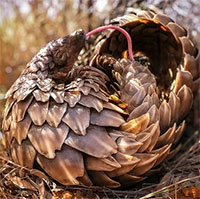

5 remarkable animals that can glide through the air, despite not being birds
The natural world is truly remarkably diverse. Some animals, despite not being birds, are skilled at soaring through the air. In this article, we look at five of the most fascinating animals that can take to the air without having wings.
Animals that glide masterfully even though they aren't birds
1. Flying rays
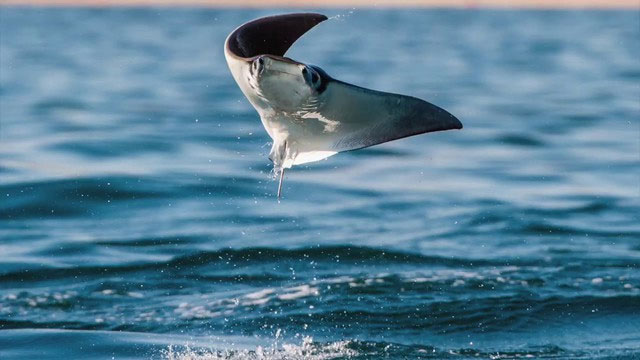
Mobula rays can leap out of the water like birds, reaching heights of up to 2 m. (Photo: NatGeo)
Flying rays, also known as Mobula, are a genus of rays in the family Mobulidae (formerly placed in the eagle ray family Myliobatidae), order Myliobatiformes. You may be surprised to learn that these fish can leap out of the water like birds, reaching heights of up to 2 m. These rays can measure up to 5.2 m across and weigh as much as 1 ton.
According to scientists, flying rays live within a narrow range and have a low reproductive rate. This forces them into fierce competition to pass on their genes. During the breeding season, flying rays gather in large schools that swim together, and this is also when they try to pair up with females. To attract a mate, the males launch themselves as high above the water as they can, then spread their "wings" to perform the most eye-catching acrobatics possible, and to increase the area that hits the water so as to make the loudest splash.
2. Flying snakes
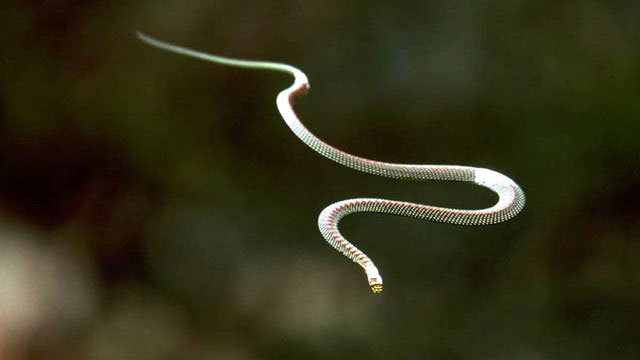
Flying snakes can glide quickly at speeds of 8 to 10 meters per second. (Photo: NatGeo).
Flying snakes, scientific name Chrysopelea, are a genus of snakes in the subfamily Ahaetuliinae of the family Colubridae. They are a group of tree-dwelling snakes found from Southeast Asia (including the three Indochinese countries: Vietnam, Laos and Cambodia) to South Asia. Flying snakes live mainly in the treetops, and they leap from branches to escape predators or hunt for prey. They can glide distances of up to about 24 m.
Jake Socha, a biologist at Virginia Tech, explains: Flying snakes have a special body structure that lets them flatten themselves as they launch into the air, and they also know how to tilt from side to side to catch the air, generating lift against gravity. Flying snakes can glide quickly at speeds of 8 to 10 meters per second.
3. Flying squid
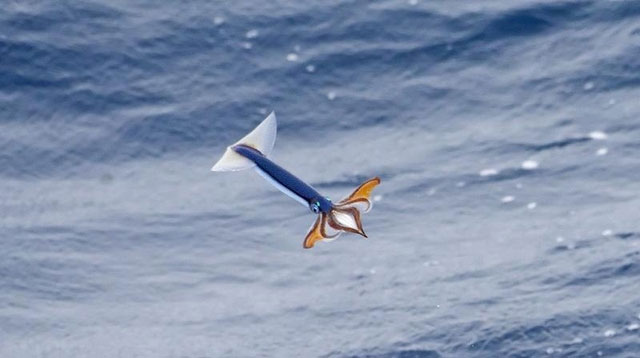
Flying squid can travel 30 m above the water's surface to escape predators or save energy during migration. (Photo: NatGeo)
The flying squid, known in Latin as Todarodes pacificus, belongs to the squid family Ommastrephidae. It lives in the northern Pacific Ocean, around the seas of Japan, China and Russia, and south along the coasts of Alaska and Canada; it is also found off central Vietnam. The flying squid is bluish, about 20 cm long, and can travel 30 m above the water's surface to escape predators or save energy during migration.
The flying squid has two fins and a siphon that draws in water from one side and expels it from the other. This is also how the squid flies. It flies backward with its tentacles trailing, while its fins act like wings to keep it balanced in midair.
4. Flying frogs
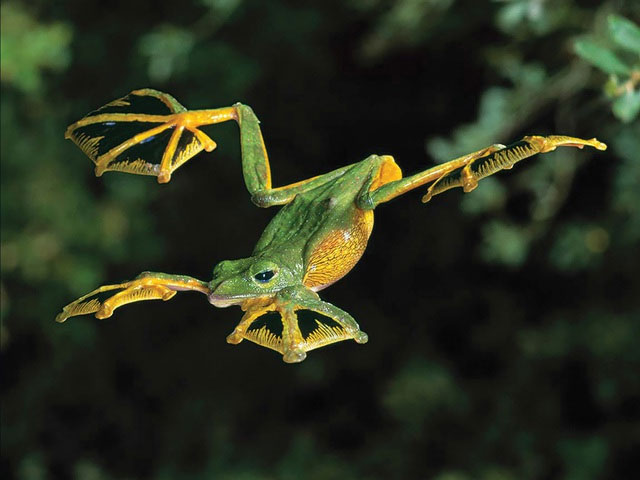
Flying frogs can easily glide down from tall trees and land softly. (Photo: NatGeo)
The flying frog, also called the gliding frog, is a species of frog in the family Rhacophoridae. It is found in China, Indonesia, Laos, Malaysia, Thailand, Vietnam, possibly Brunei, and possibly Myanmar. Thanks to its very strong limbs, webbing between its toes, large foot membranes and broad skin folds along its arms, the flying frog can easily glide down from tall trees and land softly, or sail from one tree to another without harm.
These frogs are fairly large: males measure 72.3 – 85.5 mm and females 89.4 – 90.7 mm. Males and females look alike in color. A flying frog's appearance generally matches its habitat and can change. Species living in tropical regions are often brightly colored, while those in temperate climates tend to be darker.
5. Flying squirrels (sugar gliders)
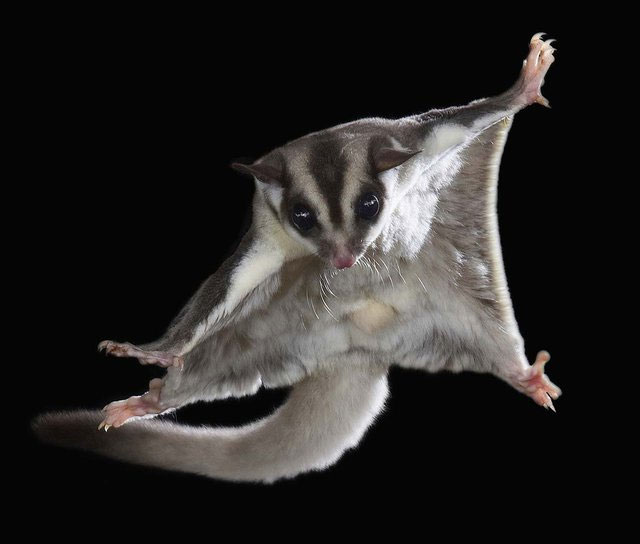
This animal can glide as far as 60 – 100 meters in just a few seconds. (Photo: NatGeo)
The animal described here as a flying squirrel is the sugar glider, a small marsupial native to Australia and New Guinea. Its body structure allows it to move easily from tree to tree. It has a thin membrane stretching along both sides of its body that works like a paraglider. Thanks to that delicate membrane, it can glide as far as 60 – 100 meters in just a few seconds. However, it cannot take off from the ground on its own and must launch itself from high up in a tree.
During the day, sugar gliders usually hide in their nests, coming out only at night to forage and roam. They spend most of their time sleeping. They have soft, bluish-gray fur and small, light bodies. In the wild, they can blend almost seamlessly into their surroundings, such as leaves and branches, making them very hard to spot with the naked eye.
How to tell the banded krait from the Malayan krait
Vietnam is home to many highly venomous snakes, notably two "siblings": the banded krait and the Malayan krait. Here's how to tell them apart.
The highly venomous Malayan pit viper is easily mistaken for this snake: Here's how to tell them apart
Both belong to the viper family Viperidae, making them easy to confuse. Here are some quick ways to tell them apart.
How to tell the king cobra, the common cobra and the oriental rat snake apart
Many accidents happen because people can't tell these snakes apart. Here's how to identify the king cobra, common cobra and rat snake.
The highly venomous cobras that live in Vietnam
Four cobra species live in Vietnam, and all of them carry potentially lethal venom. Here is how to recognize them and what to do if you meet one.
The truth about Vietnam's strange "tie the girl to the post" bird
Beyond its unusual name, the Indian cuckoo, called "bắt cô trói cột" in Vietnam, has many curious traits.
Half frog, half snake, half worm: The bizarre caecilians of Vietnam
Vietnam's 'worm frogs' are legless amphibians so snake-like that many people are startled the first time they see one.